
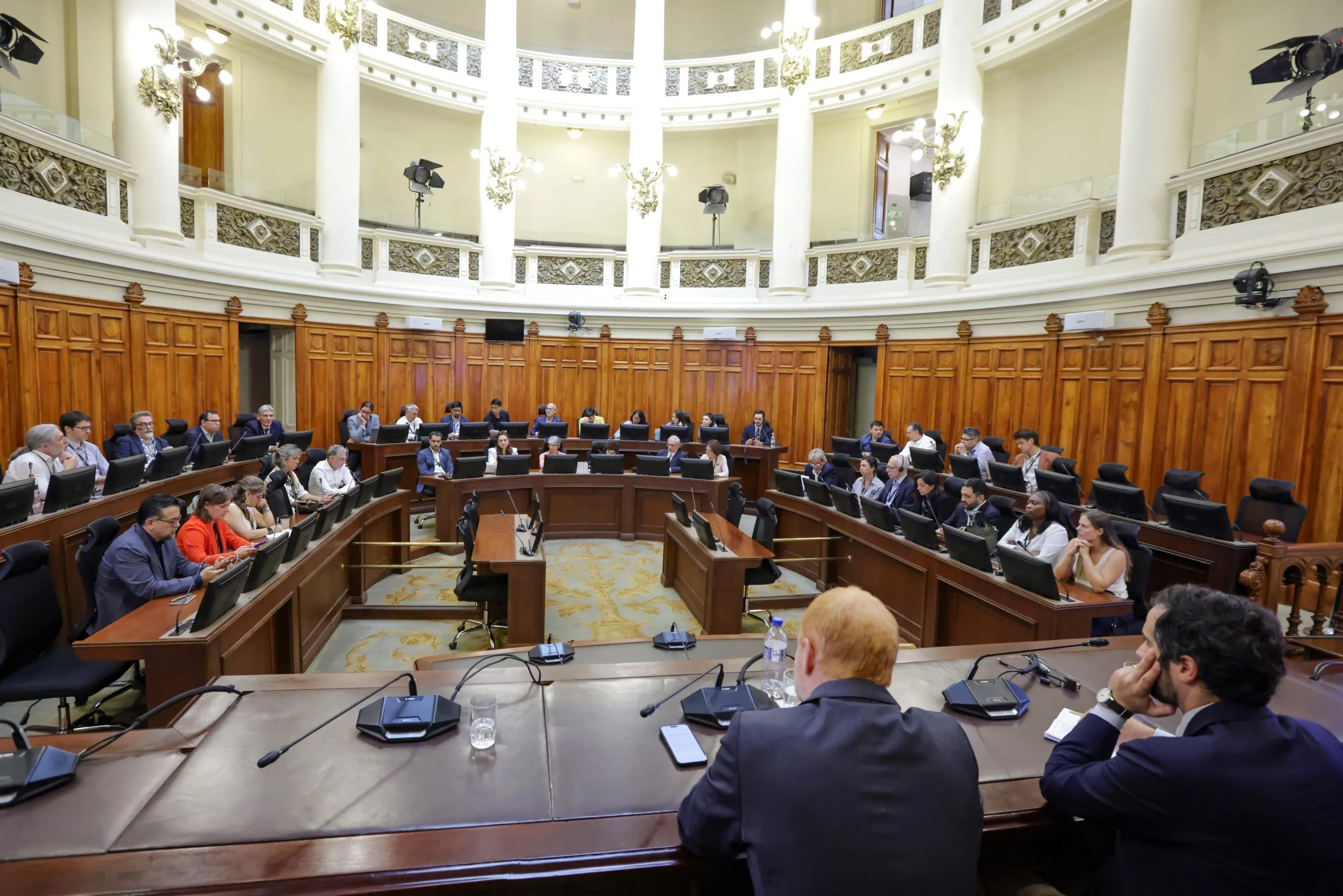
At a Latin American Science-Policy Dialogue on Solar Radiation Modification (SRM) policymakers expressed a need to better understand the topic, including by building institutional scientific capacities and identifying regional priorities.
The dialogue on SRM (also known as solar geoengineering), held in Santiago, Chile on 8–9 January 2026, was hosted by the Degrees Initiative and the Emmett Institute on Climate Change & the Environment of UCLA. The dialogue forms part of our effort to strengthen science–policy connections on SRM in the Global South.
After an introduction to the current state of science and governance of SRM, 28 policymakers and observers from ten countries explored how these technologies might intersect with Latin American social, political and environmental realities. They were joined by researchers funded by the Degrees Initiative and involved with projects in the region.
Groups then discussed what they had learned and what they wanted to know more about, including:
- the potential impacts of SRM on health, biodiversity, and agriculture;
- fitting SRM within the broader climate agenda, reflecting in particular on region-specific challenges, such as those facing Patagonia;
- the risks of SRM as both a possible stopgap and potentially slowing reductions of greenhouse gas emissions;
- building SRM scientific capacity in Latin America and stimulate ongoing conversations about SRM governance; and
- the adequacy of the term ‘SRM’ itself and the importance of more accessible language and improved public engagement.

While the first day was held at the Universidad Adolfo Ibáñez, the meeting moved to the Chilean Senate building for the second, underscoring the dialogue’s progress from a scientific foundation to governance considerations.
Following opening remarks from former Chilean Senator Juan Pablo Letelier, Prof. Juan Moreno Cruz, from the University of Waterloo, urged Latin American leaders to not wait for the Global North and to start defining their own terms for a potential future where decisions on SRM may be taken elsewhere. He suggested the region has a unique opportunity to influence the conversation and should generate its own data and reach its own political position to ensure it isn’t a passive bystander, or launchpad, for decisions made elsewhere.
The ensuing conversation ranged widely, from the need for more region-specific research and data, to the importance of Latin American voices in a conversation often dominated and led by the Global North. Participants explored the risks of SRM, including moral hazard and the possibility of the region becoming a testing ground for new technologies, and emphasised the need for transparency, local science-policy leadership, and coalition-building.
Throughout the day, recurring themes emerged: the urgency of developing regional research capacity, the importance of integrating SRM into broader climate discussions, and the need for Latin America to establish its own position and models. There was a strong sense that, while decisions about SRM might ultimately be made elsewhere, the region must be prepared, informed, and proactive as global discussions proceed.